Corbyn, Stein, and the Left’s Anti-Imperialism Problem

If you ask the British people what they think about Labour Party leader Jeremy Corbyn’s policies, it’s clear that any skepticism they may have about his economic agenda is far surpassed by misgivings about his foreign policy:
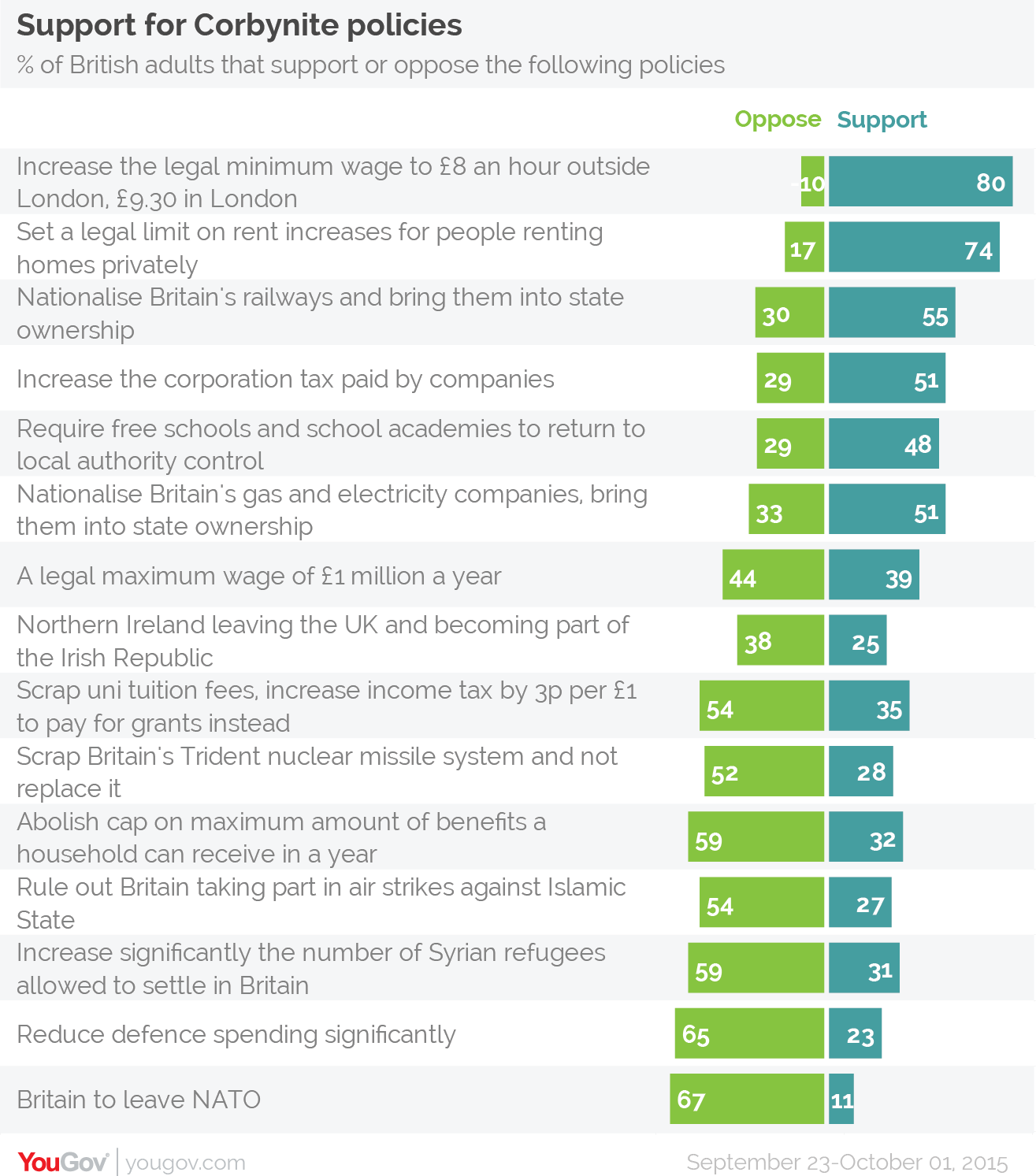
Since becoming Labour leader, Corbyn and his supporters have been accused of being “terrorist sympathizers” and anti-Semitic. This perception is tied to a suite of policy positions and attitudes which are best described as “anti-imperialist”. Left wing politicians and movements which embrace anti-imperialism face a set of political obstacles that they avoid if they jettison it. Today I’d like to think a little bit about how anti-imperialism works, both as a theory of international politics and in terms of its influence on the success and failure of the left in domestic politics.

Continue reading “Corbyn, Stein, and the Left’s Anti-Imperialism Problem”

Pence Gave Away Trump’s Biggest Policy Advantage and Kaine Didn’t Even Notice

The Vice Presidential debate last night between Tim Kaine and Mike Pence was a sad affair–Pence was able to “win” the debate without knowing any policy by repeatedly attacking Clinton’s record while only vaguely referencing policy issues. Rather than force Pence to defend his vague policy assertions, Kaine relied on a variety of canned talking points, many of which were personal attacks on Trump that moved the conversation away from the issues (Kaine repeatedly referenced my 5 bad anti-Trump arguments instead of my 5 good ones). This made Kaine look like he was running from policy, allowing Pence’s assertions to go unchallenged and giving Pence command of the room. Pence was able to accuse Kaine of running an insult-driven campaign, and Kaine’s response to that was to petulantly interrupt, get defensive, and resort to more insult-driven talking points, all of which reinforced Pence’s point. There were many claims Pence made that were open to attack, but I want to focus on one in particular today–Pence eliminated the major policy difference between his campaign’s and Kaine’s on Syria, and in so doing he eliminated the foreign policy case for Trump.

Continue reading “Pence Gave Away Trump’s Biggest Policy Advantage and Kaine Didn’t Even Notice”

Gary Johnson is Worse than Donald Trump

Since Bernie Sanders endorsed Hillary Clinton, I’ve heard a number of Sanders supporters indicate that they’re considering supporting Gary Johnson, the Libertarian Party’s nominee. We need to nip this in the bud right now. Gary Johnson is by far the most reactionary and right wing candidate in the race, especially on economic issues. I didn’t write him a candidate evaluation because in 2012 he received less than 1% of the vote, but a recent poll says 10% of Sanders supporters are now willing to support Johnson. If you are a Johnson supporter or you know someone who is, there’s some important information about Johnson and the Libertarians that everyone needs to know.

Continue reading “Gary Johnson is Worse than Donald Trump”

Donald Trump Gets Something Right: The US Can Avoid Defaults by Printing Money

Donald Trump is getting mocked on the internet for declaring that:

This is the United States government. First of all, you never have to default because you print the money. I hate to tell you. So there’s never a default.

Trump critics are crowing, accusing Trump of being ignorant of economics. There’s a lot of reason to think that Trump doesn’t know his economics (such as the outlandish tax plan he proposed). But this time Trump is right–the government really can avoid defaults by printing money. Here’s how.

Continue reading “Donald Trump Gets Something Right: The US Can Avoid Defaults by Printing Money”

What the Arab Spring Teaches Us About Armed Rebellion

Horrible things have been happening to Aleppo, a UNESCO World Heritage site and Syria’s largest city. Large parts of the old city has been destroyed, though not for the first time–the city was sacked as recently as 1440 by Tamerlane, a vicious Mongol conqueror who is estimated to have killed 5% of the world’s people. All told, the Syrian Civil War has killed more than 270,000 people, creating more than 4 million refugees and displacing 7.6 million. These high losses have not resulted in any constructive political change in Syria–Bashar al-Assad’s faction remains the strongest in the country. The conflict has made no one better off aside from the Islamic State, which has used the chaos to carve out a slice of territory for itself:

Syria and Iraq 5 May 2016

The Syrian government is red, the Iraqi government is purple, the rebels are green, Islamic State is black, and the Kurds are orange. When the Syrian Civil War started, a lot of people in the west were excited by the possibility of overthrowing the Assad regime and creating a new democracy in the Middle East. Instead we have a bloody power vacuum filled in which the only winners are terrorist organizations. What’s interesting about this is that Syria is not an isolated case–the Arab Spring revolutions that turned violent all went so badly, while those that remained peaceful sometimes achieved meaningful results.

Continue reading “What the Arab Spring Teaches Us About Armed Rebellion”