The Third Republican Debate and the Tale of the Terrible Tax Plans

In the third republican presidential debate, the moderators gave the candidates a hard time over their tax plans, and the candidates responded by accusing the moderators of being biased. Said Ted Cruz:

The questions that have been asked so far in this debate illustrate why the American people don’t trust the media. This is not a cage match. And, you look at the questions — “Donald Trump, are you a comic-book villain?” “Ben Carson, can you do math?” “John Kasich, will you insult two people over here?” “Marco Rubio, why don’t you resign?” “Jeb Bush, why have your numbers fallen?” How about talking about the substantive issues the people care about? And Carl — Carl, I’m not finished yet. The contrast with the Democratic debate, where every fawning question from the media was, “Which of you is more handsome and wise?”

This was a clever move by Cruz–republican voters have been trained to believe that the media is out to get them, to suspect that whenever the republicans get asked tough questions that the journalists’ claims are exaggerated or even fabricated. He succeeded in distracting the viewing audience from the real story of the third debate–the deeply flawed tax plans laid out by the GOP candidates.

Continue reading “The Third Republican Debate and the Tale of the Terrible Tax Plans”
The Wall Street Journal is Telling Awful Lies about Bernie Sanders

Over the last few days, I’ve seen a deeply misleading claim circulating around the internet–that Bernie Sanders is supposedly going to increase government spending by $18 trillion over 10 years. This claim originates in a Wall Street Journal article by Laura Meckler. The article is so deeply misleading that Gerald Friedman, the economist cited by the WSJ, has felt compelled to come forward and explain that his research does not at all support the WSJ’s conclusion. Indeed, Friedman claims that Sanders’ plan will actually save money. To understand how, we need to know just a little bit about healthcare economics.

Continue reading “The Wall Street Journal is Telling Awful Lies about Bernie Sanders”

I Read It So You Don’t Have To: The Art of the Deal by Donald Trump

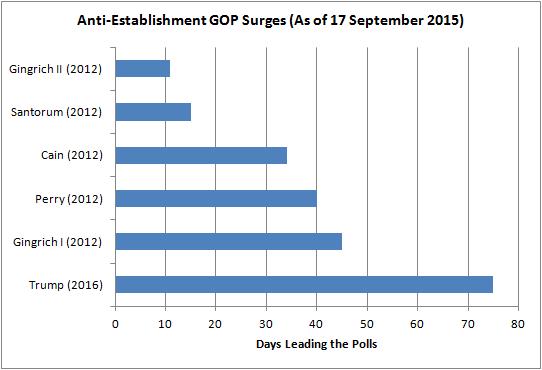
There are a lot of people out there who say that we shouldn’t write about Donald Trump. They call him a figure of fun, an entertainer. But at this point, Donald Trump has been leading in the national republican primary polls for longer than any of the anti-Romneys we saw in 2012:

GOP Surges

The day may come when Trump no longer leads in the polls, but it is not this day–despite the claims of pundits to the contrary, far more viewers picked Trump as the winner of yesterday’s GOP debate than picked any other candidate:

2nd Republican Debate Survey

So I think it’s appropriate to take Trump seriously, to really try to figure out what makes him tick and what his appeal is. To that end, I have acquired and read, cover to cover, The Art of the DealTrump’s 1987 bestseller. I am now prepared to share what I have learned with you.

Continue reading “I Read It So You Don’t Have To: The Art of the Deal by Donald Trump”

Candidate Evaluations: Chris Christie

Chris Christie has waded into the presidential race, so let’s evaluate him. I’ll be looking at Christie’s background, policy history, and explicit statements to determine whether or not he would make a good president. I won’t be paying attention to electability or likeability, as is often common elsewhere on the web.

Continue reading “Candidate Evaluations: Chris Christie”

Candidate Evaluations: Donald Trump

Donald Trump is running for president. A few people have told me I shouldn’t do an evaluation for Trump, that to write one for him treats him with a level of seriousness he’s not entitled to. But here’s the deal folks–as of late May and early June, Donald Trump polls at 4% among republican primary voters. That may not sound like a lot, but he has roughly twice as many supporters as George Pataki, Carly Fiorina, Lindsey Graham, or Rick Santorum. In some polls, he also tops Rick Perry. And as we’ve seen over the course of this series, there are a great many serious candidates for president who have said outlandish things or taken reactionary positions. So I’m going to do an evaluation for Trump, because he really isn’t that much crazier or that much less popular than many of the republican candidates I’ve already done. Before we begin, here’s a quick reminder of what we’re doing. I’ll be evaluating Trump’s background, policy history, and explicit statements to determine whether or not he would make a good president. I won’t be paying attention to electability or likeability, as is often common elsewhere on the web. Continue reading “Candidate Evaluations: Donald Trump”