
Today I’d like to take a mental trip back across the pond and examine the current double dip recession in the United Kingdom, investigating the role it plays as a case study in the policy debate between advocates of stimulus (state spending increases) and advocates of austerity (state spending decreases).
Tag: politics
Fiscal Cliff Madness
Sneaking up on the US government, slowly but surely, is the fiscal cliff–the agreement congress made to cut spending across the board in many sensitive areas if a bipartisan deficit reduction plan could not be agreed to. This was a bad idea from the outset, but you wouldn’t know it from listening to the Democratic Party, and that’s both a problem, and the topic of today’s post.
Stimulus vs. Austerity: USA
I keep seeing a certain political sentiment expressed. It goes a little something like this, from James Pethokoukis of the New York Post:
So what’s the problem with the Obama recovery? Why is it the weakest since the Great Depression?
Maybe it’s the Obama policies, like a stunning disregard for the trillion-dollar deficits that are likely already a dead weight on growth. Or maybe it’s the Obama guarantee of more tax hikes and regulation that makes US business too worried to hire and invest.
But it’s not too late to start shrinking unproductive government, cut debt and reduce penalties on work and investment — just like in those recoveries that we used to know.
Then there are the political cartoons, things like this:
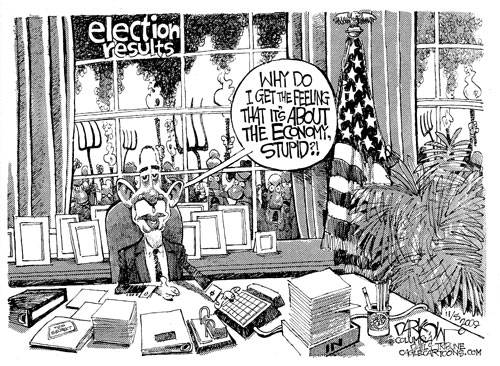 Here’s the structure of the idea:
- The economic recovery has been insufficiently strong
- Therefore, we should do the opposite of what Obama has done
- Ergo, vote Romney/Ryan 2012
The first point is correct, the other two points are simplistic and anti-intellectual, and I intend to illustrate both how and why.

