
There’s a lot of fear in the United States and elsewhere with regard to a rising China. Many people are worried about the amount of government debt China possesses, or how so many jobs in industry and manufacturing have moved over there. Increasingly, China and the United States are being compared to one another as if their power outlay were more or less equal–in Pakistan for instance, the numbers are more or less even on the question. However, there are several key reasons why Sinophobia is exaggerated and unnecessary, and they comprise today’s topic.
Tag: GDP
Utilitarianism and Equality
One of the key topics in moral philosophy is utilitarian ethics–the notion that some principle or concept, usually happiness or pleasure or some variant, should be maximised across society. Famously created by Jeremy Bentham, the system of ethics has attracted many famous supporters over the years, most notably John Stuart Mill. However, many writers and theorists critical of utilitarian ethics, including John Rawls, have claimed that utilitarianism attempts to justify high inequality, forcing some to toil in misery for the gain of others. Today I’d like to explore this criticism of utilitarianism to see if it holds water.
The Demise of the Scientific Breakthrough?
Yesterday, I ran across a new paper from economist Robert Gordon that suggests that long-term innovation and technological development may be slowing, at least in the case of breakthrough technologies. I found Gordon’s paper interesting, and would like to use today’s post to discuss it and its possible future implications.
Continue reading “The Demise of the Scientific Breakthrough?”
Stimulus vs. Austerity: UK
Today I’d like to take a mental trip back across the pond and examine the current double dip recession in the United Kingdom, investigating the role it plays as a case study in the policy debate between advocates of stimulus (state spending increases) and advocates of austerity (state spending decreases).
Stimulus vs. Austerity: USA
I keep seeing a certain political sentiment expressed. It goes a little something like this, from James Pethokoukis of the New York Post:
So what’s the problem with the Obama recovery? Why is it the weakest since the Great Depression?
Maybe it’s the Obama policies, like a stunning disregard for the trillion-dollar deficits that are likely already a dead weight on growth. Or maybe it’s the Obama guarantee of more tax hikes and regulation that makes US business too worried to hire and invest.
But it’s not too late to start shrinking unproductive government, cut debt and reduce penalties on work and investment — just like in those recoveries that we used to know.
Then there are the political cartoons, things like this:
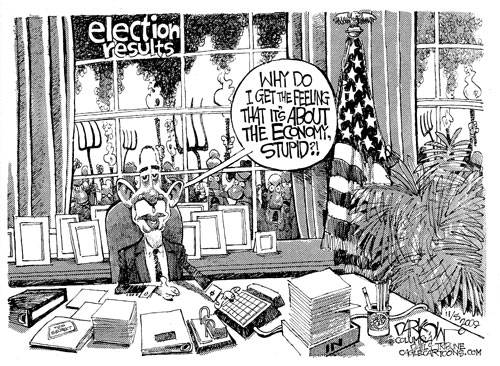 Here’s the structure of the idea:
- The economic recovery has been insufficiently strong
- Therefore, we should do the opposite of what Obama has done
- Ergo, vote Romney/Ryan 2012
The first point is correct, the other two points are simplistic and anti-intellectual, and I intend to illustrate both how and why.
 Benjamin Studebaker