How the War in Ukraine Ends

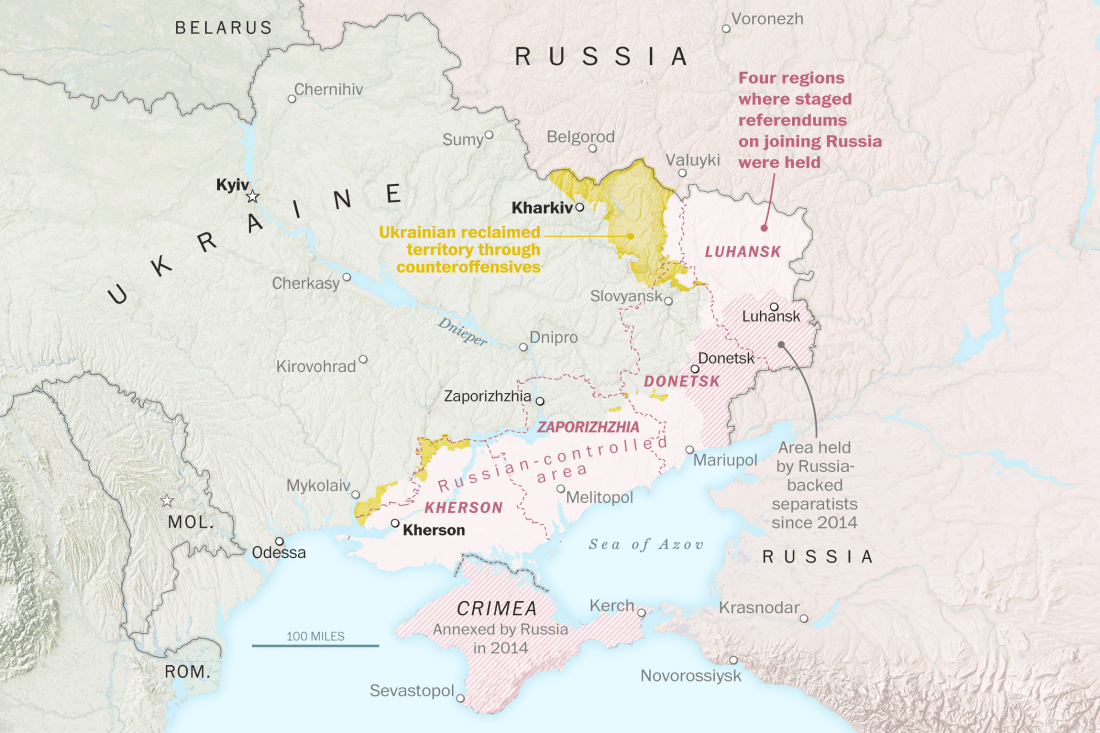
Russia has moved ahead with annexing the occupied oblasts of Ukraine. This is a point of no return for the Putin regime. It is hard for the regime to maintain its legitimacy when it is trying and failing to invade a foreign country. The regime looks weak and incompetent, and with no real possibility of replacing the leadership through an election, there is no easy to way to restore confidence on short notice. But as difficult as that situation is, it is much harder for the regime to maintain its legitimacy when it is trying and failing to defend the territory the regime acknowledges as part of Russia. A Russian president who cannot successfully invade Ukraine is weak. A Russian president who cannot defend Russia is pathetic. The decision to annex the oblasts therefore sends a clear message–the Putin regime will defend the territory it now holds, or it will die trying.

Continue reading “How the War in Ukraine Ends”

What the Arab Spring Teaches Us About Armed Rebellion

Horrible things have been happening to Aleppo, a UNESCO World Heritage site and Syria’s largest city. Large parts of the old city has been destroyed, though not for the first time–the city was sacked as recently as 1440 by Tamerlane, a vicious Mongol conqueror who is estimated to have killed 5% of the world’s people. All told, the Syrian Civil War has killed more than 270,000 people, creating more than 4 million refugees and displacing 7.6 million. These high losses have not resulted in any constructive political change in Syria–Bashar al-Assad’s faction remains the strongest in the country. The conflict has made no one better off aside from the Islamic State, which has used the chaos to carve out a slice of territory for itself:

Syria and Iraq 5 May 2016

The Syrian government is red, the Iraqi government is purple, the rebels are green, Islamic State is black, and the Kurds are orange. When the Syrian Civil War started, a lot of people in the west were excited by the possibility of overthrowing the Assad regime and creating a new democracy in the Middle East. Instead we have a bloody power vacuum filled in which the only winners are terrorist organizations. What’s interesting about this is that Syria is not an isolated case–the Arab Spring revolutions that turned violent all went so badly, while those that remained peaceful sometimes achieved meaningful results.

Continue reading “What the Arab Spring Teaches Us About Armed Rebellion”

No, We Should Not Arm Ukraine

In a recent report titled Preserving Ukraine’s Independence, Resisting Russian Aggression: What the United States and NATO Must Do, the Brookings Institution in conjunction with the Atlantic Council and the Chicago Council on Foreign Affairs advise NATO to drastically increase its arms commitment to Ukraine. The report has fundamentally misunderstood the nature of the conflict in Ukraine and has consequently given governments advice that is both irrelevant and terrible. Here’s why.

Continue reading “No, We Should Not Arm Ukraine”

Does the US/China Emissions Deal Make a Difference?

Recently the United States and China agreed to a carbon emissions reduction deal to combat global warming. Under the terms of the deal, the US agrees to reduce emissions by 26% to 28% from 2005 levels by 2025, while China agrees to reach peak emissions by 2030, and to generate 20% of its energy with zero-emissions technology by that year. Diplomacy is notoriously difficult, and consequently any deal on climate change heartens those who watch international politics. But are these emissions reductions sufficient to avert the worst of what global warming potentially has to offer? I’m not seeing much coverage of the deal from a climate science perspective, so I decided to look into it.

Continue reading “Does the US/China Emissions Deal Make a Difference?”