The US-Canada Trade War

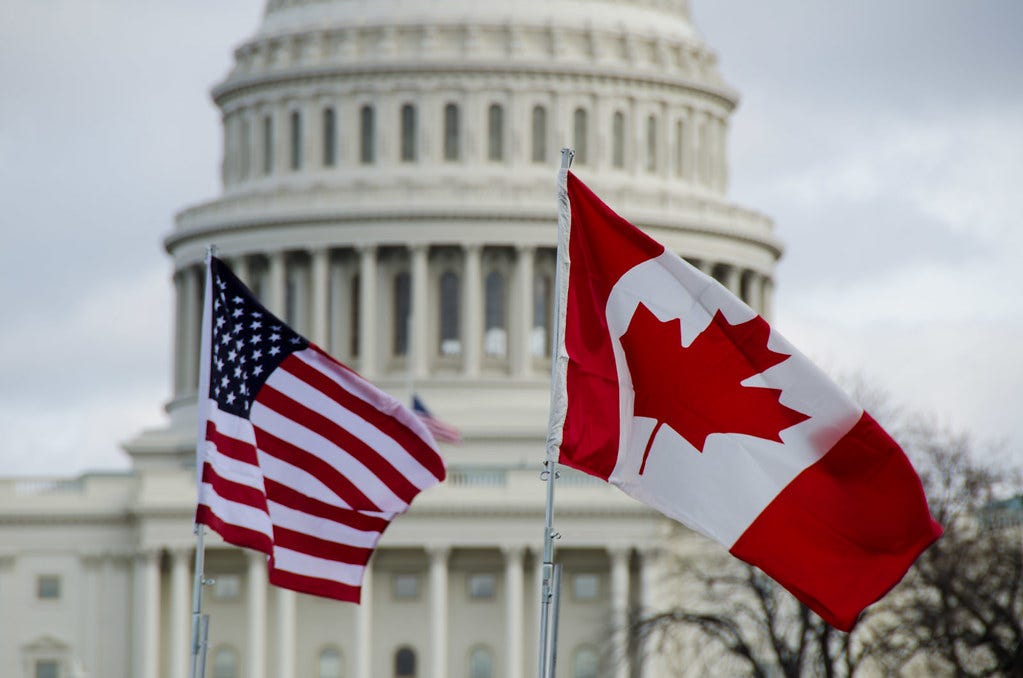
President Trump has announced new tariffs:

  • 25% on all Canadian imports, closing the loophole on imports valued at less than $800, with a lower 10% rate for energy, i.e., oil & gas
  • 25% on all Mexican imports
  • 10% on all Chinese imports, on top of the targeted tariffs Trump introduced in his first term (and which President Biden first retained and then expanded)

These tariffs are much larger than the tariffs Trump imposed during his first term. Those tariffs were targeted – they affected specific industries Trump was hoping to reshore. This is a broad-spectrum approach. It’s a strategy you use to force another state to make concessions in other policy areas. What is Trump trying to do? And will he succeed?
Continue reading “The US-Canada Trade War”

Two New Essays for Isonomia

I have two new essay out for Isonomia. The first, “On Whether Various Economic Schemes Can Improve Citizens’ Political Capabilities,” reflects on the different strategies liberal theorists employ to ensure democratic citizens have the capabilities necessary to participate effectively. I argue that all these strategies fall short, because there is a reluctance on the part of liberal theorists to grapple with the cost of creating citizens who really can perform the necessary political work. It was a ton of fun to write, and you can read it here:

The second, “Federations and Foreign Policy: The Quest for Koinon,” explores why political federations like the United States stop expanding. Instead of continuing to incorporate more states as co-members, these federations begin building military bases in foreign states and compelling those states to become clients. I argue that federations have historically been based rather heavily around security and this has made it difficult to use them to reform the global economic system. While elites are willing to pay the cost of integrating territory when this is necessary for their own survival, they become more resistant when this integration is no longer strictly necessary. You can read it here:

Green New Deal is More New Deal Than Green

Like many of you, I’ve seen that clip of Senator Dianne Feinstein (D-CA) arguing with children about the Green New Deal. If you haven’t seen it, I have it right here for you:

In and amidst the hostility, Feinstein said something quite honest in this exchange:

Well, it’s [climate change] not going to get turned around in 10 years.

I have a certain admiration for honest centrism. So often these days, politicians pretend to be more radical than they are to excite voters, only to disappoint them. But it’s not merely because we can’t get the votes in a Republican senate to pass the Green New Deal. No–it’s because the United States is at this point no longer capable of cutting its own emissions enough to deal with climate change, and it’s unlikely to successfully lead other states in this direction even if it tries.

Continue reading “Green New Deal is More New Deal Than Green”

The Paris Climate Agreement’s Failure Was Structurally Inevitable

President Trump has pulled the United States out of the Paris Climate Agreement:

https://www.youtube.com/watch?v=v_yIrCFNc74

Unfortunately, the Paris Agreement was poorly designed from the start and never really had a chance of meaningfully addressing climate change. Trump’s decision today was produced and facilitated by these weaknesses.

Continue reading “The Paris Climate Agreement’s Failure Was Structurally Inevitable”