
In 2014, I finished an MA thesis at the University of Chicago. In that thesis, I argued that as economic inequality increased, American politics would return to the sharp political divisions of the 1930s, with both left-wing and right-wing radical movements popping up all over the place. Recently, I finished a PhD thesis at the University of Cambridge. In that thesis, I argued that while economic inequality does cause legitimation problems, those problems are fundamentally different in kind from the problems of the 1930s. I reversed my position from 2014, and I did so even as most people in the American media and intelligentsia arrived at the position which I formerly held. If I stuck by my old position from 2014, it would be advantageous to my career development. There is increasingly a lot of appetite for expert accounts which play up the threat Donald Trump poses to democracy. Any well-credentialed political theorist or political scientist who can compellingly tell stories about executive coups from the 20th century and draw parallels to Trump can now sell many books without much trouble. The issue is that these parallels are rubbish. Here’s why.
Continue reading “American Democracy is in No Imminent Danger”Liberalism’s War on the Internet
Over the past few weeks, the occupation of the capitol building by pro-Trump demonstrators has legitimated a raft of security measures. The War on Terror is now the War on the Internet. In the wake of Brexit and the election of Donald Trump, liberalism has become aware of the danger posed to it by the internet. On the internet, discourse proliferates rapidly, in an uncontrolled and unmediated way. Many web users begin to develop positions which are incompatible with liberal pluralism, which paint their political opponents as enemies who must be comprehensively destroyed. During the 90s, 00s, and early 10s, the internet was not treated seriously by liberal theory. The triumph of the populists in the mid-10s forced liberalism to reckon with it. Now liberalism is trying to change the internet into something compatible with liberalism.
Continue reading “Liberalism’s War on the Internet”Why Larry Summers is Wrong About $2,000 Stimulus Checks
Larry Summers, the former director of the National Economic Council under President Obama, has publicly spoken out against the $2,000 stimulus checks proposed by Bernie Sanders and President Trump. Summers’ argument is simple–the checks are projected to increase disposable personal income as a ratio of GDP to an unusually high level. For Summers, the fact that this figure would be elevated above normal levels is itself cause for concern. But the situation we are in is unprecedented, and it calls for an unprecedented response. Let’s run through some of the arguments.
Continue reading “Why Larry Summers is Wrong About $2,000 Stimulus Checks”Jimmy Dore, AOC, and Medicare-For-All Strategy
The American left is finally discussing Medicare-For-All strategy again, thanks to Jimmy Dore’s suggestion that House Democrats could demand a floor vote on the legislation in exchange for backing Nancy Pelosi’s next term as Speaker. For too long, we haven’t been discussing our substantive goals and the available strategies for pursuing them. We’ve been locked in grim, repetitive discussions of coronavirus and the presidential election. But Dore got Medicare-For-All back on the front burner. And how have we rewarded him? He’s been subject to a slew of malicious, personal attacks. Instead of engaging with Dore’s argument, many of Dore’s opponents have turned to ad hominem, arguing that we shouldn’t listen to the argument simply because it comes from Jimmy Dore.
Continue reading “Jimmy Dore, AOC, and Medicare-For-All Strategy”The Unfolding Economic Catastrophe in Europe
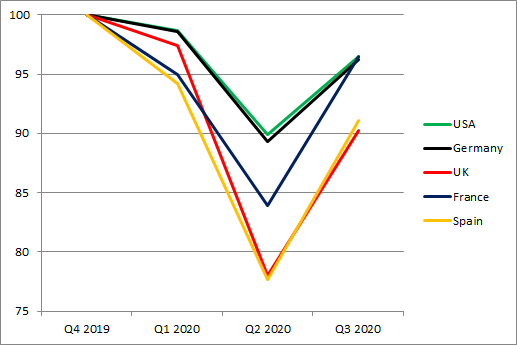
As the figures for the third quarter come in, I am growing very worried about the future of Europe. Coronavirus has unleashed a disaster there that is hard to comprehend. The numbers are extraordinarily terrible. Let me show you what I mean.
Continue reading “The Unfolding Economic Catastrophe in Europe” Benjamin Studebaker