Universal Basic Income Isn’t About Now–It’s About Later

In reading the recent piece by Daniel Zamora at Jacobin and some of the reactions to it, I’ve been struck by how limited the conversation about universal basic income (UBI) is. For the uninitiated, UBI is fairly straightforward–instead of having social programs like welfare or food stamps which people qualify for on the the grounds that they fall below some income threshold, UBI gives everyone a set minimum income. UBI has fans and detractors across the political spectrum because depending on how it’s constructed it could be made to do very different things. Some on the right want to use it to reform welfare and some of the left want to use it to make work optional. Some in both camps want to use it to help workers displaced by automation or outsourcing. The key problem with the conversation is that it tends to be based around whether we could or should implement UBI now, or very soon. This misunderstands what makes UBI interesting. Properly understood, UBI is not about today. It’s about capitalism’s endgame–what the world looks like when capitalism truly exhausts itself.

Continue reading “Universal Basic Income Isn’t About Now–It’s About Later”
Trump Welcomes the Hatred of the Press

Remember back during the 2016 campaign when the media couldn’t stop covering Donald Trump? It hasn’t really changed, has it? The press hasn’t adapted much. Yes, there’s a lot of content about how bad Trump is, and some of it is even policy-oriented, focusing on some of the more odious bits and pieces of the Trump tax plan. But this is having no impact on Trump’s approval rating, which has hovered in the mid to upper 30s for most of the first year of his presidency–higher than the low 30s figures he suffered from throughout most of the 2016 campaign. Why is it that nothing the media says or does seems to seriously harm Trump?

Continue reading “Trump Welcomes the Hatred of the Press”

How the Democratic Party Can Win the South

Since Donald Trump’s election I have increasingly become interested in how the left engages with white America. The left isn’t getting enough white support. Even with over 90% of the African-American vote, alleged pedophile Roy Moore came absurdly close to winning in Alabama. This can’t just be because white Americans are racist, stupid, or evil. There has to be more to it. In the past I’ve identified many things wrong with our approach–we’re too condescending and patronising toward white voters, and too quick to blame and shame them. We don’t spend enough time talking about and emphasizing programs and policies that help all marginalized people, including poor, working, and middle class whites. But today I want to go further and discuss in detail a new way of looking at the South and at middle America more broadly–one that takes these people and their concerns seriously. If we’re willing to tell a different story about the South, or at least acknowledge a different story, and build that acknowledgement into our policy and rhetoric, I think we can make some gains.

Continue reading “How the Democratic Party Can Win the South”

The Doug Jones Victory Belongs to the People of Alabama, Not Just African-Americans

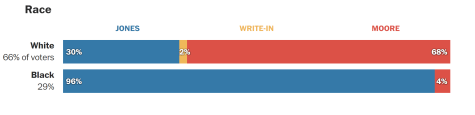
In the past week there’s been a weird narrative in the media about the Alabama Senate race between Democrat Doug Jones and Republican (and alleged serial mall predator) Roy Moore. The story goes something like this: the bad white southerners were willing to vote for the scummy pedophile theocrat, but then black people showed up and saved America from Roy Moore. It’s built on two key facts–most white Alabamans voted for Moore and the overwhelming majority of black Alabamans voted for Jones:

But this seems like a bizarre and misleading way to interpret the result of this election. Here’s why. Continue reading “The Doug Jones Victory Belongs to the People of Alabama, Not Just African-Americans”