The Democratic Party Debate: 5 Reasons Why Sanders Won and Clinton Lost

I watched the first Democratic Party debate, hosted by CNN. CNN also hosted the second Republican Party debate, and in both debates it tried to get the candidates to fight each other on camera for the entertainment of the viewing public, repeatedly asking questions designed to get candidates to criticize or attack one another. In the republican debate, this tactic worked perhaps too well–the debate deteriorated into a series of personal attacks, with little relevant policy content. For that reason, I didn’t bother to write up an analysis of the second republican debate–there was little of substance to analyze. The democratic candidates did a better job of resisting their baser instincts, and we did manage to get some interesting exchanges on serious policy issues, particularly between Bernie Sanders and Hillary Clinton. In these exchanges, it was quite clear that Sanders was the winner–his arguments were significantly stronger and more convincing than Clinton’s.

Continue reading “The Democratic Party Debate: 5 Reasons Why Sanders Won and Clinton Lost”

Trident: How Important is an Independent Nuclear Deterrent?

Britain’s leader of the opposition, Jeremy Corbyn, has declared his opposition to the use and possession of nuclear weapons:

Specifically, he wants to discontinue Britain’s Trident nuclear program. Trident consists of four submarines, 58 Trident II D-5 ballistic missiles, and 160 thermonuclear warheads. All together, Britain has the 5th largest nuclear program in the world:

How important is this program to Britain’s security? On this issue, I think both Corbyn and his critics have oversimplified matters a bit. The role nuclear weapons play is more complicated than both hawks and doves typically acknowledge.

Continue reading “Trident: How Important is an Independent Nuclear Deterrent?”

I Read It So You Don’t Have To: The Art of the Deal by Donald Trump

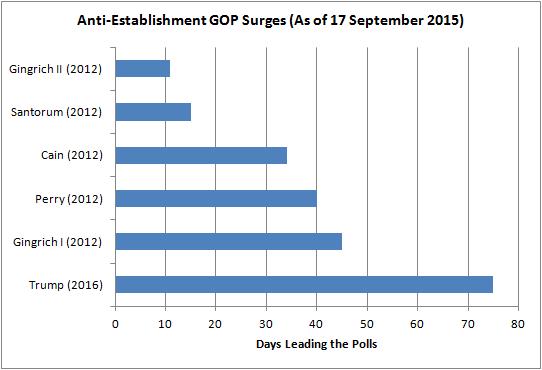
There are a lot of people out there who say that we shouldn’t write about Donald Trump. They call him a figure of fun, an entertainer. But at this point, Donald Trump has been leading in the national republican primary polls for longer than any of the anti-Romneys we saw in 2012:

GOP Surges

The day may come when Trump no longer leads in the polls, but it is not this day–despite the claims of pundits to the contrary, far more viewers picked Trump as the winner of yesterday’s GOP debate than picked any other candidate:

2nd Republican Debate Survey

So I think it’s appropriate to take Trump seriously, to really try to figure out what makes him tick and what his appeal is. To that end, I have acquired and read, cover to cover, The Art of the DealTrump’s 1987 bestseller. I am now prepared to share what I have learned with you.

Continue reading “I Read It So You Don’t Have To: The Art of the Deal by Donald Trump”

Yemen: The American Catastrophe No One is Talking About

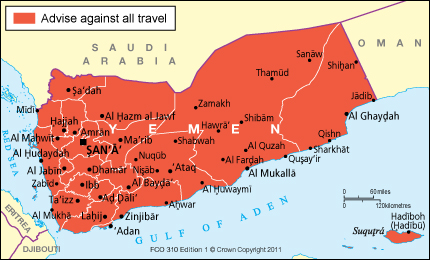
Everyone knows about what a mess Iraq and Syria are. Libya is still a disaster, but even that country once had our attention. This is a story about Yemen. Remember Yemen? It’s the box-like country on the southwest corner of the Arabian peninsula:

Yemen is in the grip of a civil war that has now killed over 4,300 people. It’s an omnishambles. Let me tell you the horrible story of how we turned this country into the war-torn dystopia it now most assuredly is.

Continue reading “Yemen: The American Catastrophe No One is Talking About”

Candidate Evaluations: Jim Gilmore

Jim Gilmore is a late addition to the presidential race. This means it’s time for one more candidate evaluation. I’ll be looking at Gilmore’s background, policy history, and explicit statements to determine whether or not he would make a good president. I won’t be paying attention to electability or likeability, as is often common elsewhere on the web.

Continue reading “Candidate Evaluations: Jim Gilmore”