The Function of Marianne Williamson’s Candidacy

Marianne Williamson is running against President Biden in the Democratic primaries. As I write this, she is the only declared candidate, though Biden has given every indication that he will run for a second term.

I don’t have anything against Williamson personally or against her religious views. But there is a lot of evidence that Williamson is a weak candidate who cannot mount a competitive primary campaign against Biden. In this piece, I will present this evidence to you, and I will make the case that Williamson’s candidacy creates the illusion that the primary is being contested when in fact there is no meaningful left-wing opposition to Biden within the Democratic Party. This is not to suggest that Williamson herself intends to create this illusion or has any negative intentions of any kind. Nevertheless, her decision to run allows party apparatchiks to pretend the party is ideologically diverse and welcomes internal dissent when in point of fact it does not.

Continue reading “The Function of Marianne Williamson’s Candidacy”

A Class Analysis of the Twitter Crisis

In recent weeks, there have been extensive conflicts between Twitter workers and Twitter’s new owner, Elon Musk. One user made an attempt to analyze the conflict in class terms, framing it as a clash between “entrepreneurial capital” and the “professional-managerial class”:

I think this badly misreads the situation. The professionals who work at Twitter are wage-earners who don’t even have a labor union. They don’t dominate anything. But it also made me think–why isn’t there a better class-based reading of the conflict? Let’s give it a go.

Continue reading “A Class Analysis of the Twitter Crisis”

The Midterm Elections Don’t Matter

As the midterm elections approach, the political class is working very hard to increase voter turnout. President Biden has given a big speech accusing the Republicans of posing a grave threat to democracy. We are inundated with political ads in which the Democrats accuse the Republicans of plotting to ban abortion and the Republicans accuse the Democrats of causing inflation. None of the arguments offered by either side have much to do with reality, and it is increasingly difficult to find anyone who will even make a sincere effort to discuss what’s going on without incorporating distorted partisan messaging. If we look at the issues, it’s clear that the composition of Congress is not going to make much difference over the next two years.

Continue reading “The Midterm Elections Don’t Matter”

How the War in Ukraine Ends

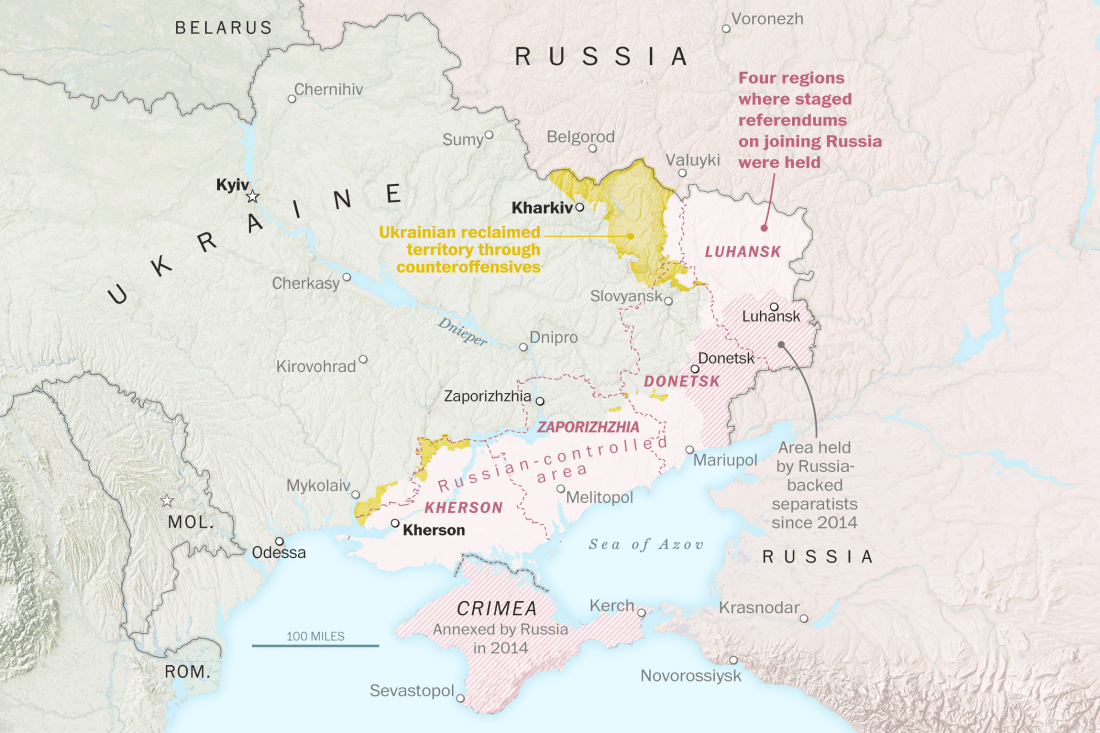
Russia has moved ahead with annexing the occupied oblasts of Ukraine. This is a point of no return for the Putin regime. It is hard for the regime to maintain its legitimacy when it is trying and failing to invade a foreign country. The regime looks weak and incompetent, and with no real possibility of replacing the leadership through an election, there is no easy to way to restore confidence on short notice. But as difficult as that situation is, it is much harder for the regime to maintain its legitimacy when it is trying and failing to defend the territory the regime acknowledges as part of Russia. A Russian president who cannot successfully invade Ukraine is weak. A Russian president who cannot defend Russia is pathetic. The decision to annex the oblasts therefore sends a clear message–the Putin regime will defend the territory it now holds, or it will die trying.

Continue reading “How the War in Ukraine Ends”

The Republican Model and the Crisis of National Liberalism

I’ve published a piece in Cosmos + Taxis about some of the tensions between nationalism and liberalism. Cosmos + Taxis‘ readership skews libertarian, and many of its readers are frustrated with the constraints nationalism imposes upon liberalism. There’s a lot of right libertarian interest in republicanism and federalism. I make the case that republicanism can only compete with nationalism insofar as republics offer citizens more extensive sets of rights–including economic rights–than they can have through nationalism. In this way, I pitch the libertarians on adopting more conventionally left-wing economic positions. It’s a sincere effort to make an argument that might be appealing to someone with a rather different set of starting points from my own. You can read the whole thing here.