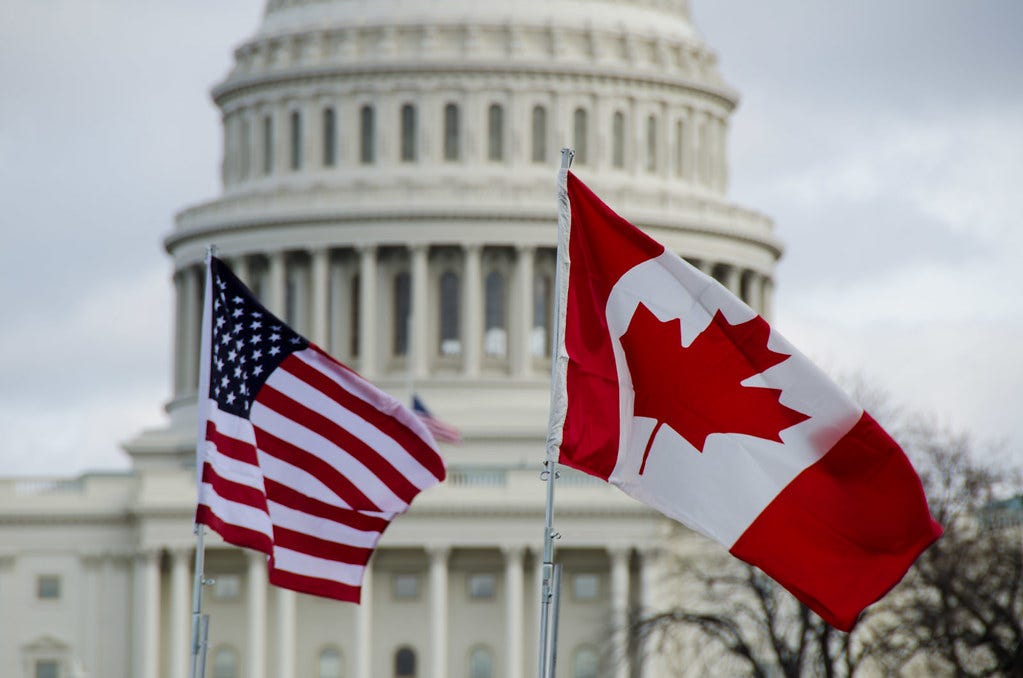
The US-Canada Trade War

President Trump has announced new tariffs:

  • 25% on all Canadian imports, closing the loophole on imports valued at less than $800, with a lower 10% rate for energy, i.e., oil & gas
  • 25% on all Mexican imports
  • 10% on all Chinese imports, on top of the targeted tariffs Trump introduced in his first term (and which President Biden first retained and then expanded)

These tariffs are much larger than the tariffs Trump imposed during his first term. Those tariffs were targeted – they affected specific industries Trump was hoping to reshore. This is a broad-spectrum approach. It’s a strategy you use to force another state to make concessions in other policy areas. What is Trump trying to do? And will he succeed?

Continue reading “The US-Canada Trade War”

Two New Essays for Isonomia

I have two new essay out for Isonomia. The first, “On Whether Various Economic Schemes Can Improve Citizens’ Political Capabilities,” reflects on the different strategies liberal theorists employ to ensure democratic citizens have the capabilities necessary to participate effectively. I argue that all these strategies fall short, because there is a reluctance on the part of liberal theorists to grapple with the cost of creating citizens who really can perform the necessary political work. It was a ton of fun to write, and you can read it here:

The second, “Federations and Foreign Policy: The Quest for Koinon,” explores why political federations like the United States stop expanding. Instead of continuing to incorporate more states as co-members, these federations begin building military bases in foreign states and compelling those states to become clients. I argue that federations have historically been based rather heavily around security and this has made it difficult to use them to reform the global economic system. While elites are willing to pay the cost of integrating territory when this is necessary for their own survival, they become more resistant when this integration is no longer strictly necessary. You can read it here:

The Midterm Elections Don’t Matter

As the midterm elections approach, the political class is working very hard to increase voter turnout. President Biden has given a big speech accusing the Republicans of posing a grave threat to democracy. We are inundated with political ads in which the Democrats accuse the Republicans of plotting to ban abortion and the Republicans accuse the Democrats of causing inflation. None of the arguments offered by either side have much to do with reality, and it is increasingly difficult to find anyone who will even make a sincere effort to discuss what’s going on without incorporating distorted partisan messaging. If we look at the issues, it’s clear that the composition of Congress is not going to make much difference over the next two years.

Continue reading “The Midterm Elections Don’t Matter”

The Rump Professional Class and Its Fallen Counterpart

I’ve been thinking about the professional class–the class which sits between the wealthy billionaires and the ordinary workers. The professionals are college-educated and they are traditionally paid more than ordinary workers. But as economic inequality grows and the position of workers becomes more precarious, the professionals are less secure than they used to be. A university degree no longer guarantees a stable, robust standard of living, but it still separates those who have it from those who do not. Why? Because college students are socialised to pursue the degree as a means of demonstrating their merit. When that merit goes unrewarded, young would-be professionals grow very cross. They want their virtue to be recognised. Unable to earn more or enjoy a higher living standard than the workers, the would-be professionals retreat into the cultural realm. They use the language and ideas they learned at university to assert their moral superiority, gaining an imaginary victory over the workers. This condescension leads the workers to resent the professionals in turn, and makes it very difficult for these downwardly mobile professionals to form political alliances with the workers. All of this, of course, perpetuates the dominion of the rich.

To use a metaphor, the professionals are the house slaves of capitalism–they identify with the owners because they live better than the field slaves and are invited to participate in and contribute to the culture of the owners. But once they are deprived of their superior living standard and opportunity to culturally contribute, they can defend their feeling of superiority only by mocking the field slaves for being unable to read.

This is not to say that the whole of the professional class is going this way. Some college educated people still enjoy the economic and cultural advantages which historically belonged to all or most college-educated people. I want to explore how this group–what I call the “rump professional class”–interacts with the downwardly mobile group, which I call the “fallen professional class”.

Continue reading “The Rump Professional Class and Its Fallen Counterpart”