
President Trump has announced new tariffs:
- 25% on all Canadian imports, closing the loophole on imports valued at less than $800, with a lower 10% rate for energy, i.e., oil & gas
- 25% on all Mexican imports
- 10% on all Chinese imports, on top of the targeted tariffs Trump introduced in his first term (and which President Biden first retained and then expanded)
These tariffs are much larger than the tariffs Trump imposed during his first term. Those tariffs were targeted – they affected specific industries Trump was hoping to reshore. This is a broad-spectrum approach. It’s a strategy you use to force another state to make concessions in other policy areas. What is Trump trying to do? And will he succeed?
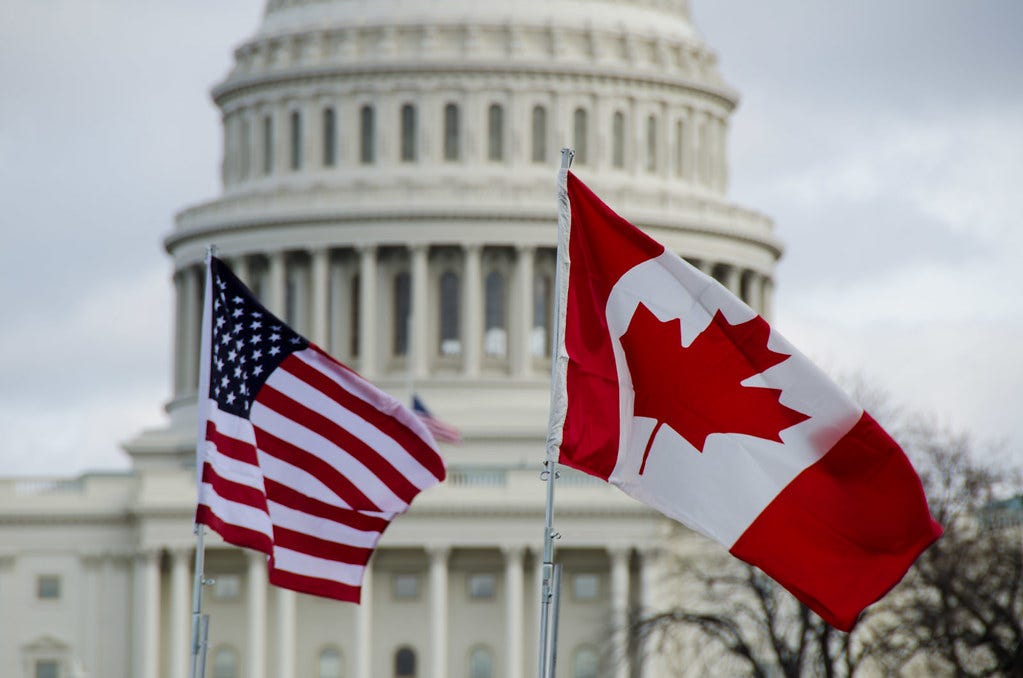
Unlike a Lot of Stuff Trump Does, this Actually Matters
During the first Trump administration, NAFTA (North American Free Trade Agreement) was renegotiated. Canada and Mexico made very mild concessions in exchange for an agreement that was otherwise nearly identical to the one that preceded it. These tariffs flagrantly violate that agreement. They are not about changing its terms – they are about forcing Canada and Mexico to adopt, at minimum, new border policies.
When Trump was first inaugurated, there was a lot of hullaballoo about the executive orders he signed in front of the cameras. But many of these orders reinstated old policies from Trump’s first administration. Those that went further will be subjected to judicial review. The order to freeze federal aid has already been held up by the courts.
This is different. These tariffs are clearly within the president’s legal powers. Congress delegated the emergency tariffing power to the president, and only congress can take that power away. Yet so far, the reaction from republican senators has been muted. The administration has indicated it may offer agricultural aid to farmers affected by retaliatory tariffs. This program is perceived to have been effective when it was previously implemented during the first Trump administration. So, while some US senators have expressed concerns about the tariffs, it seems unlikely that they will immediately respond with legislation circumscribing the president’s tariffing power.
This matters, especially for Canada. Canada is exceptionally dependent on the United States. Its exports to the United States are valued at over $400 billion. The total GDP of Canada is just over $2 trillion. A 25% tariff is far from trivial, and it applies to a huge part of the Canadian economy. Canada is a wealthy country. Its citizens are accustomed to an extremely high standard of living. They will not respond well to these tariffs. There are also major questions about what Trump wants from Canada. Is this just a question of border security, or does it go further than that? Is Trump looking for Canada to fulfill NATO security obligations? Is he trying to create a crisis in Canada that might result in its annexation?
In Mexico, where political and economic disturbances are relatively common, the government may weather this more successfully. It’s clear what Mexico can do to get tariff relief – it can spend more to secure its borders. This is not just about the US-Mexico border, but the Latin American border as well. The Trump administration is concerned not simply (or even primarily) with immigration from Mexico, but with immigration from other Latin American and South American countries. Many people pass through Mexico on their way to the United States, and one of Trump’s goals will be to get Mexico to do more to limit that migration. It shouldn’t be too hard for the United States and Mexico to make a deal – the cost of the security measures is much smaller than the economic impact of the tariffs.
In the case of China, these tariffs escalate an effort at decoupling that has a long history in US foreign policy. President Obama tried to induce businesses to leave China through the Trans-Pacific Partnership, a free trade deal that would have encouraged US businesses to locate in other friendly states (e.g., Vietnam or the Philippines) rather than China. Trump abandoned the TPP in his first term, instead preferring tariffs. Biden opted to stick with Trump’s strategy, retaining the Trump tariffs and then going on to expand them. There’s a question about how effective this will be – US goods imports from China fell by just 6% between 2016 and 2020. There were huge increases in imports from the friendly states (Vietnam, in particular, did extremely well), but the trade volume between the United States and China has nonetheless remained very large. These tariffs may speed up this process, and that may have significant long-term effects on the structure of the international system.
The tariffs on China accelerate something that’s long been in the works. The tariffs on Mexico are just another instance of the United States playing hardball in Latin America. What really matters here are the tariffs on Canada. This is a major change in the US-Canada relationship, and we should take it seriously.
The Price Canada has Already Paid
Even before these tariffs were announced, the possibility of them caused major political instability in Canada. This past December, Canada’s finance minister and deputy PM resigned from the cabinet, citing a lack of confidence in Prime Minister Justin Trudeau’s ability to respond effectively to the tariffs.
This triggered a major crisis for Trudeau’s government. It was already in a weak position. Trudeau has been prime minister since 2015. The liberals have lagged in the polls since 2022, trailing quite heavily since the middle of 2023. They hold a minority in the Canadian House of Commons, relying on the New Democratic Party to help pass major bills.
After the finance minister’s resignation, the NDP demanded Trudeau’s resignation, threatening an early election. Trudeau tried to use the Christmas holidays to play for time but ultimately acquiesced. His party is now holding an internal leadership contest to replace him – that election will be held on March 9. Liberal Party members will choose the new leader through a ranked ballot mechanism, with lagging candidates progressively eliminated until a single contender possesses a majority. There are five declared candidates currently in the running.
The Price Canada is Yet to Pay
It gets even messier. There is a general election scheduled for October 20th. The Conservatives are currently leading in the polls, and their leader – Pierre Poilievre – has often appeared friendly to Trump. Now, Poilievre is trying to project unity. He’s rejected Trump’s proposal to add Canada to the United States, and he’s expressed a willingness to carry retaliatory tariffs forward should he become Prime Minister later this year. But his history makes him appear, at the very least, to be a more pliable negotiating partner than any likely future liberal PM. When challenged on these tariffs by wavering republican senators, Trump can use this coming Canadian election to shore up resolve. Poilievre can try to undermine this with public statements, but will he be believed?
The Liberal Party can use Poilievre’s history of friendliness to the Americans to their electoral advantage. They can frame Poilievre’s conservatives as an American fifth column. It probably won’t be enough to win them an election in what will surely be dire economic circumstances – but it could help the liberals limit the number of seats they lose. Of course, if they do this, it will only increase the perception south of the border that Poilievre will be more pliable, increasing the willingness of the administration to drag out the fight.
These tariffs are high enough to cause very serious damage to the Canadian economy over the course of the next nine months. The United States has tools it can use to protect itself. It has the fiscal capacity to pay off its farmers and weather the storm. Canada has much less powder. The fact that the election will not be held until October makes it much more likely that the trade war will last longer than Canada can manage. What happens at that stage? Very sizable concessions, I would imagine.
The Trump administration didn’t have to launch all of these tariffs at once. It is expressing a high level of confidence that it can prevail in a multi-front trade war. It is even talking about further expanding the battle to include the European Union. Suppose a deal is cut quickly with Mexico, or suppose the tariffs on China meaningfully accelerate friendshoring? Very quickly, Canada could become isolated in a bilateral struggle with the United States. The Canadian economy simply isn’t big enough to win that kind of fight.
What’s the best-case scenario for Canada? The Trump administration bites off more than it can chew. If it expands the trade war too much too fast too soon, it will eventually pay an inflationary price that compels the senate republicans to act against it. But how long will it take for inflation to become sufficiently evident for the senate republicans to act? Even in this situation, Canada would pay a high price before getting relief.
What Can Canada Do?
If I were the next liberal Prime Minister of Canada, I’d make a show of publicly attempting to begin negotiations with the Trump administration. If there is a way to cheaply and easily end the trade war now, before the effects are felt, I’d want to find it. And if the Trump administration’s demands are unreasonable, I’d want that unreasonableness made clear to the public on both sides of the border.
I wouldn’t worry about looking tough. The liberals are likely fated to lose the October election no matter what they do. Canada’s best hope is that Trump overreaches and faces an inflationary crisis that compels a response from the republicans in the senate. Canada can’t achieve this by imposing tariffs of its own. It needs much bigger, more powerful states to get into the game. By looking weak and pathetic, it can encourage Trump to underestimate the resolve of more significant players. If he continues to add belligerents, he may reach a point where he’d welcome a white peace with Canada. If, on the other hand, Canada plays it very tough, Trump may take more care to ensure he wins this confrontation before moving on to the rest.
Indeed, if I were Trudeau, I might try this tactic now, before the new leader is chosen next month. By trying this right away, I would absorb criticism for this attempt, protecting my successor from its taint. If the negotiations fail and a prolonged trade war develops, my successor would be able to project a greater level of resolve than I showed, marginally strengthening the party’s position going into October.
Unfortunately, the Liberal Party doesn’t seem to think this way about the trade war. It’s intent on imposing retaliatory tariffs and escalating the mess. This will make it worse for ordinary people on both sides of the border. It is unlikely to improve the outcome for Canada, and it may even cause Trump to take a special interest in the Canadian front. That is not in Canada’s interest – Canada benefits when the United States’ attention is directed elsewhere.
The astounding thing is that the Canadian government doesn’t understand this. The Prime Minister has more than a decade of experience. Yet he has, repeatedly, made public statements that attract negative attention from the president and his supporters. He’s operated on the premise that Trump would not be elected again in 2024, that Canada would not have to deal seriously with him. This was and is a mistake, and ordinary Canadians will pay for it.
 Benjamin Studebaker